

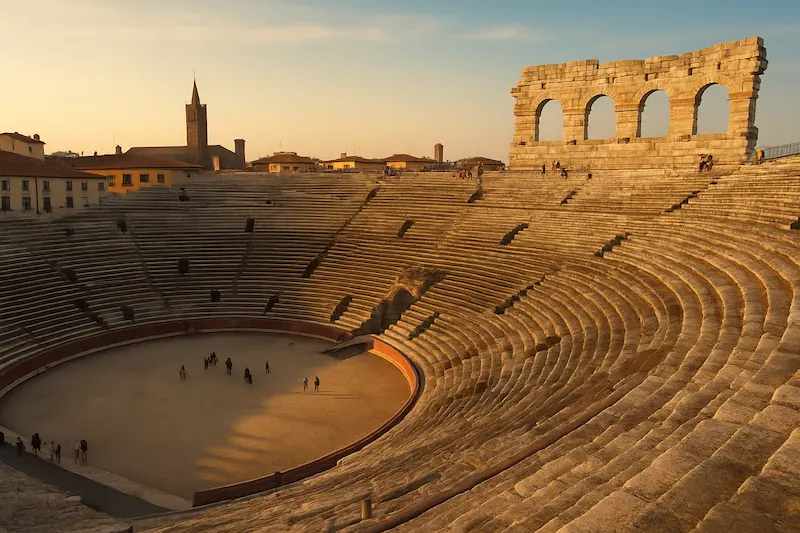
The Verona Arena is one of the world’s most extraordinary monuments, a place where 2,000 years of history still echo through stone arches shaped by the Roman Empire. Built in the first century AD, the Arena was designed to impress, entertain, and gather thousands of spectators beneath the open sky. Its perfect elliptical shape, remarkable acoustics, and monumental size made it one of the greatest amphitheaters of the ancient world.
In Roman times, the Arena hosted the spectacles that defined public life: gladiator combats, exotic animal displays, and staged battles meant to celebrate power, bravery, and the spirit of the empire. Crowds of up to 30,000 people filled the stone steps, cheering for their champions as dust rose from the arena floor. These events were more than entertainment; they were a social ritual, a moment where the entire city came together.
As centuries passed, the Arena survived earthquakes, wars, and political changes. During the Middle Ages, it became a marketplace and a gathering point for civic life. In the Renaissance, travelers and scholars admired its monumental presence, calling it one of the most impressive Roman structures still standing outside Rome.
The true rebirth of the Arena came in the 20th century, when it transformed into one of the world’s most iconic open-air venues. Today, it hosts internationally renowned concerts and the famous Verona Opera Festival, where voices resonate exactly as Roman engineers intended two millennia ago. Artists from every corner of the globe perform here, turning each evening into a unique meeting between ancient stone and modern art.
Visiting the Verona Arena is more than a step back in time. It is an encounter with a monument that has never stopped living, adapting, and inspiring. Whether you come for history, architecture, or music, the Arena stands as a breathtaking reminder that some masterpieces are truly timeless.